AddiWire

Additive manufacturing news and European prices, with independent expert commentary

Desktop 3D printing

Review: Prusa CORE One+ INDX toolchanger prints faster and wastes less than Bambu H2C

Published 1 sourceDeutsche Version
Review: Prusa CORE One+ INDX toolchanger prints faster and wastes less than Bambu H2C
Image: Tom's Hardware

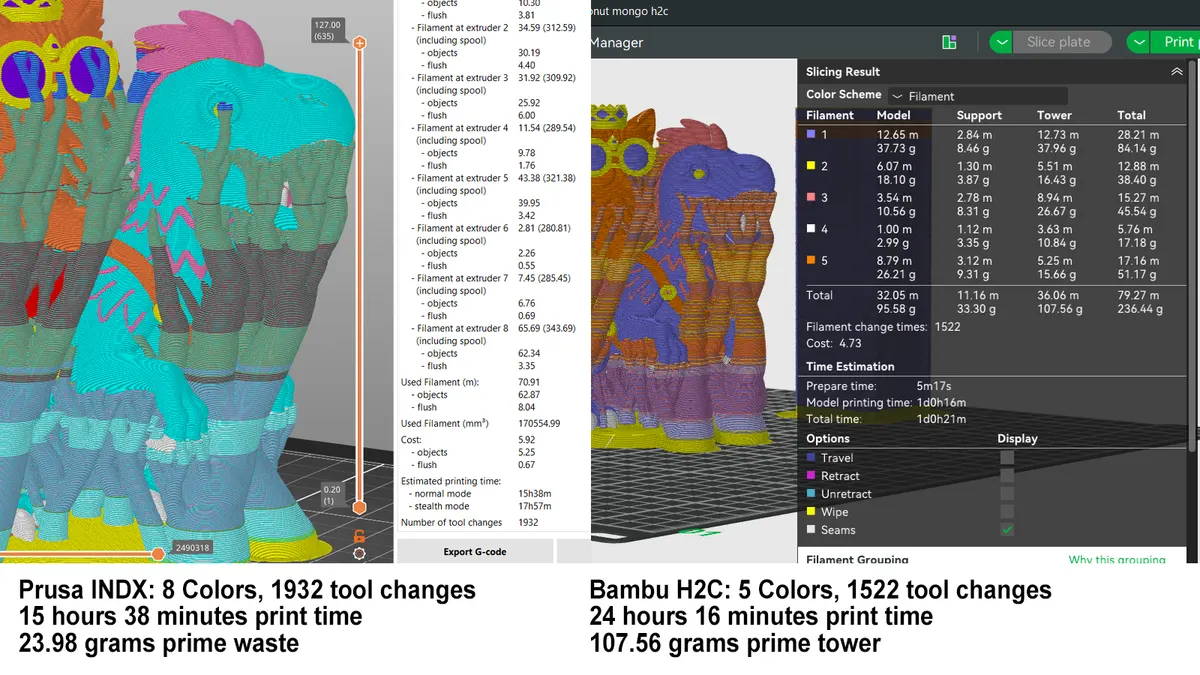
Tom's Hardware has reviewed the Prusa CORE One+ INDX, a desktop toolchanger built with Bondtech that uses induction-heated toolheads and drops the prime tower. In the reviewer's comparison print against the Bambu Lab H2C it finished almost nine hours sooner, wasted about 84 g less material and used three more colors. Prices run from 1,699 to 2,119 dollars for complete machines.

Key facts
  • Complete printers cost 1,699 dollars (four toolheads) to 2,119 dollars (eight toolheads)
  • Conversion kits for an existing CORE One cost 749 dollars (four) or 999 dollars (eight)
  • Wiper ejects a filament blob of about 13 mg instead of a prime tower
  • Against the Bambu Lab H2C: nearly nine hours faster, 83.58 g less waste, three more colors

How does the INDX toolchanger work?

INDX stands for Induction Dynamic Extruder. It is a joint project: Prusa Research supplies the platform, here the CORE One+ Gen 2, and Bondtech supplies the toolhead system. The passive nozzles hold no moving parts, only a nozzle and a filament path, and the single smart head heats them by induction. It picks each nozzle up from a rack at the front of the chamber, using magnets.

Compared with the standard CORE One+, the rack costs 15 mm of build depth and 2 mm of width. An automatic tool offset calibration sensor sits in a front corner and needs only to be kept clean. The reviewer also notes the printer can print ASA and ABS with the door closed, helped by active chamber temperature control that reaches 55 C using bed heat.

How does it avoid the prime tower?

Toolchangers already waste less than single-nozzle multicolor machines, but they still need to prime nozzles. The INDX replaces the prime tower with a wiper that ejects a blob of about 13 mg, smaller than a grain of rice, into a waste container on the outside of the machine.

In the reviewer's test of one model with similar settings on both machines, the INDX was nearly nine hours faster than the Bambu Lab H2C, produced 83.58 g less waste excluding supports, and used three more colors.

What does it cost and how is it sold?

A DIY kit with four toolheads starts at 1,699 dollars, and an assembled eight-toolhead machine with Buddy Cam and advanced filtration costs 2,119 dollars. Owners of a CORE One can convert it for 749 dollars (four toolheads) or 999 dollars (eight). Prusa quotes 5 to 6 hours for the conversion, while the reviewer needed most of a weekend for the early Founder's Edition. Single tools are listed at 45 dollars on Bondtech's site, and the system is also sold there as a kit for other open-source printers.

What it means

This is a consumer and prosumer review, so its main relevance is for prototyping, jigs and low-volume polymer parts rather than qualified production. Less purge waste and shorter multicolor print times lower the cost per part for visual models and fixtures, but the figures come from one reviewer's comparison print, not a controlled study. Buyers should check material range and long-term toolhead reliability before planning around it.

Earlier on AddiWire

Frequently asked questions

What is the Prusa INDX?

It is a toolchanger system developed by Prusa Research and Bondtech with induction-heated smart head and passive nozzles, offered on the CORE One+ with up to eight toolheads.

How does the INDX avoid a prime tower?

A wiper ejects a blob of about 13 mg of filament into an external waste container, replacing the prime tower used by other toolchangers.

Can an existing CORE One be upgraded?

Yes, conversion kits cost 749 dollars for four toolheads and 999 dollars for eight, with Prusa quoting 5 to 6 hours of installation.

Read the original reports
  1. Tom's Hardware 3D printing, 20 Sept 2026

This summary was written with the help of AI from the linked reports, under the editorial responsibility of Svetozar Kolesar.