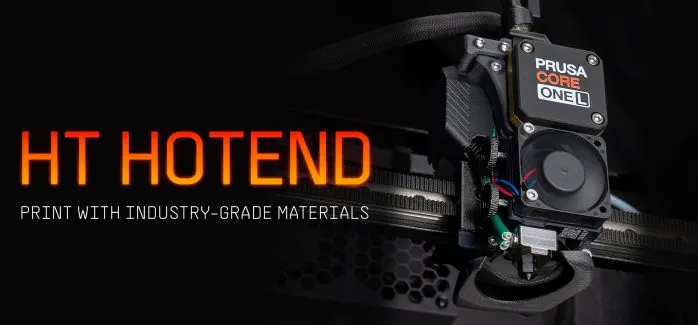
Prusa Research has released the HT Hotend, a quick-swap 400 °C upgrade for the CORE One+ and CORE One L+, together with HighTemp build sheets and three new filaments: PPS-CF, PPS-GF and PPA-CF Core. The company positions the setup as a lower-cost route to engineering polymers than a dedicated industrial machine, though the 60 °C chamber limits the most demanding materials.
Key facts
HT Hotend prints up to 400 °C and swaps in under a minute
Chamber temperature is 60 °C, limiting PEKK-A CF and similar materials
Context Interlayer adhesion describes how well each printed layer bonds to the one below, and it is usually the weakest direction of an FDM part.
What does the HT Hotend change for the CORE One+ and L+?
The HT Hotend raises the printing temperature to 400 °C and can be swapped for another hotend in under a minute. It is sold as an upgrade for existing printers or factory-mounted on a new CORE One L+. It is not compatible with INDX. Prusa argues that high-temperature printing is usually costly both because of the materials and because of the specialised machines they normally need.
Which existing materials benefit?
Printing above 300 °C improves interlayer adhesion of several Prusaments that also run on a standard hotend. Prusa reports measured gains of 23 % for PA11 Carbon Fiber, 18 % for ASA, and 7 % each for PC Blend and PC Blend Carbon Fiber.
Which new filaments and sheets are offered?
Three filaments join the e-shop: Siraya Tech Fibreheart PPA-CF Core, Fiberon PPS-CF10 and Fiberon PPS-GF20. PPA-CF is described as resistant to oils and fuels up to 199 °C when annealed, and PPS as having the highest chemical resistance, UL94 V0 rating and thermal resistance of 252 °C. The glass fibre PPS is aimed at electronics housings because it does not block radio signals. A HighTemp sheet, already available for the Prusa Pro HT90, is now offered for the CORE One+ and L+ for materials such as PEI, PEEK, PEKK, PPSU and PPS.
What are the limits and precautions?
The 400 °C nozzle would allow materials such as PEKK-A CF, but the 60 °C chamber is the limiting factor, so only small parts may work. Prusa recommends filtration, since most high-temperature materials emit dangerous fumes, and a Prusa USS Drybox, because materials like PEI1010 absorb moisture within hours.
What it means
For small and mid sized manufacturers, this lowers the entry cost for trials with PPS and PPA parts, for example jigs, housings or chemically exposed fixtures. The limits matter: a 60 °C chamber, fume handling and strict filament drying add effort, and the adhesion gains are Prusa's own measurements. Parts for qualified or safety relevant use would still need independent testing of the printed material, not data sheet values.
Frequently asked questions
Is the HT Hotend compatible with every Prusa printer?
It is offered for the CORE One+ and CORE One L+, either as an upgrade or factory-mounted on a new CORE One L+. It is not compatible with INDX.
Can the CORE One print PEKK or PEEK with the HT Hotend?
The 400 °C nozzle allows materials such as PEKK-A CF, but the 60 °C chamber is the limiting factor, so such materials may only work for small components.
Why does Prusa recommend filtration and a drybox?
Most high-temperature materials emit dangerous fumes, and filaments like PEI1010 absorb moisture within hours, which makes successful prints nearly impossible.