Tom's Hardware has reviewed the Creality Pika, a compact handheld 3D scanner on pre-order for 699 dollars. The reviewer rates it among the best scanners tested in 2026 for its portability, price and the Creality Scan software, while noting that it is less precise than the Sermoon series and needs a fairly powerful phone or computer.
Key facts
Pika weighs 260 g with batteries and costs 699 dollars on pre-order
Blue laser mode uses seven parallel lines, with 0.03 mm single frame accuracy
Marker-free laser scanning works only when connected to a computer by cable
Output formats include STL, OBJ and PLY, via the Creality Scan software
Context Structured light scanning projects a known light pattern onto an object and calculates its shape from how the pattern deforms, while laser line scanning sweeps lines across the surface.
What does the Creality Pika offer?
The Pika is a small handheld scanner shaped like a point-and-shoot camera and weighing 260 g with its rechargeable AA-sized batteries. It offers two modes: blue laser scanning with seven parallel lines, and near-infrared structured light. The review lists a single frame accuracy of 0.03 mm for the laser mode and up to 0.08 mm per metre for structured light, with a laser working distance of 160 to 400 mm.
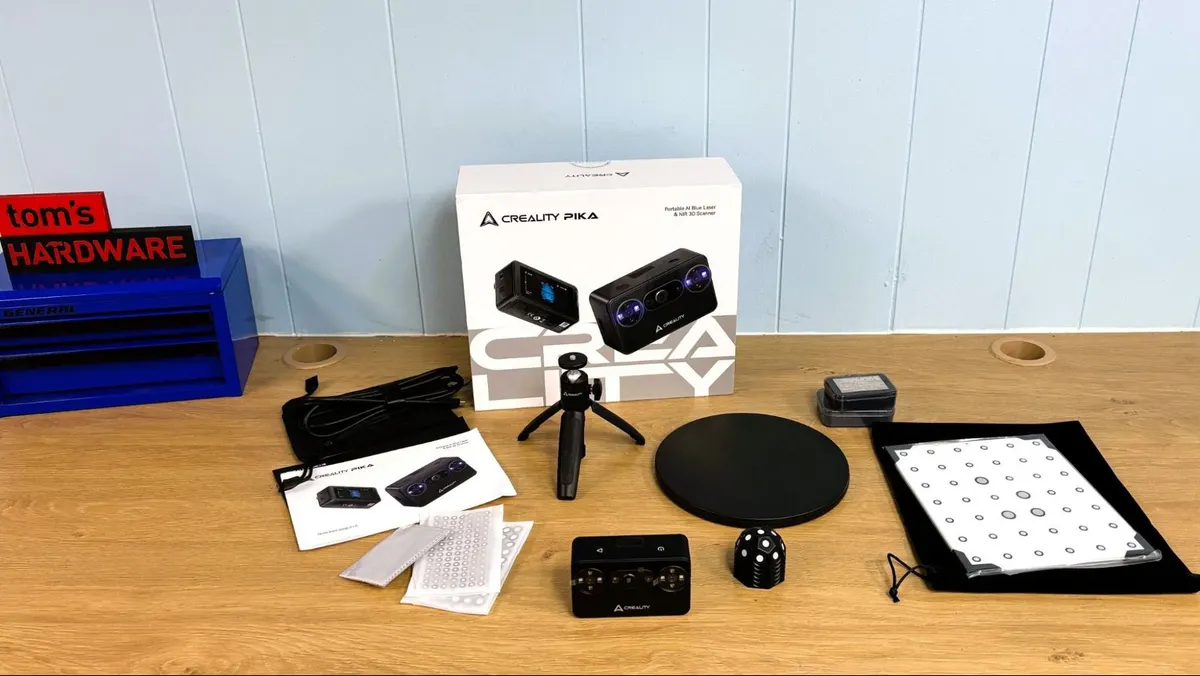
In the box are a tabletop tripod, a glass calibration board, a manual turntable, marker dots and spare batteries. Calibration with the glass board takes about ten minutes. A small screen on the back shows the scan in progress or lets the user adjust exposure and zoom.
What are the limits in use?
The scanner passes much of the processing to the connected device, so hardware matters. The reviewer found that an iPhone 15 was just sufficient, and an older laptop with 8 GB of RAM did not work, while a low-end gaming laptop with 16 GB did. Creality lists 16 GB of RAM and an Nvidia GPU with 8 GB of VRAM as the minimum for Windows. Wireless connections are slower, and marker-free laser scanning requires a cable.
The included manual turntable has some play in its centre bearing, which can roughen the scan surface. The printed quick start guide is little more than a packing list.
How did the test scans turn out?
The reviewer scanned a bust of Michelangelo's David, a small toy figure 62 mm tall and a bobblehead. Creality Scan was used to fuse the data, remove marker dots and noise, clip the base, fill holes, smooth and simplify the mesh. Results were reprinted on a Prusa Core One L and a Prusa XL in PLA and described as nearly perfect. The review notes that the light weight made it easier to reach undercut areas such as the underside of the hair and chin.
What it means
For small manufacturers, a scanner at this price makes reverse engineering of simple parts, fit checks and quick copies of worn components affordable. It is not a metrology tool: the quoted accuracy figures come from the vendor specification, and the review tested visual and hobby-type models, not tolerance-critical parts. Hardware requirements add hidden cost. This follows the earlier AddiWire reports on Bambu Lab's planned S1 scanner, which points to consumer scanning becoming a competitive segment.
The review gives a pre-order price of 699 dollars, with a listed release date of July 22, 2026.
Can the Pika be used with a phone?
Yes, it can connect wirelessly to a phone running the Creality Scan app, but the phone must be fairly powerful. Marker-free laser scanning needs a cable connection to a computer.
Which file formats can it export?
The specification lists OBJ, STL and PLY output, and the review also mentions ASC export from Creality Scan.